
Spinal Decompression vs. Physical Therapy
Most patients have done physical therapy before considering decompression. The question isn't which is "better" — it's why spine-specific rehabilitation serves a different function from general PT.
The Short Answer
They're Not Competing. They're Doing Different Things.
Physical therapy is broad-spectrum rehabilitation. It strengthens muscles, improves mobility, corrects movement patterns, and builds functional capacity. It's widely effective and widely recommended — for good reason.
Spinal decompression — more accurately described as spine-specific rehabilitation — targets a specific problem at a specific spinal level. It uses computer-controlled cyclical loading to influence the disc environment directly, working at the mechanical level that general exercise and manual therapy can't reach.
Comparing them is like comparing a full-body fitness program to a surgery for a torn ligament. One builds general function. The other addresses a specific structural issue. The best outcomes often involve both.
What PT Does Well
Physical Therapy's Strengths
Physical therapy excels at building the support system around your spine. Core strengthening, postural correction, flexibility training, pain education, and movement re-training all contribute to long-term spinal health.
For many spinal conditions — particularly those driven by muscular weakness, poor movement patterns, or deconditioning — physical therapy alone may be sufficient. Clinical guidelines consistently recommend it as a first-line conservative intervention.
The limitation isn't what PT does. It's what it can't do. No amount of core strengthening can mechanically unload a compressed disc segment or create the cyclical pumping effect that may support disc nutrition through diffusion. PT strengthens the structure around the problem. It doesn't directly address the disc environment itself.
"I did months of physical therapy and my disc problem is still there. What now?"
If PT improved your strength and mobility but your disc-level symptoms persist, it doesn't mean PT failed — it means the disc-specific component of your problem may require a disc-specific intervention. That's where spine-specific rehabilitation enters the picture. Many patients do both.
What Decompression Adds
Addressing the Disc Directly
When a specific disc level has been identified as the primary pain generator — through imaging and clinical evaluation — decompression targets that segment with computer-controlled cyclical loading designed to bypass muscle guarding and support disc nutrition. See the full mechanism →
This is something physical therapy exercises cannot replicate. You can strengthen the muscles around a compressed disc, but you can't voluntarily create the specific mechanical environment that decompression provides through structured, computer-controlled protocols.
This is also why the best decompression providers integrate supportive rehabilitation — stretching, strengthening, postural work — alongside decompression. The therapy addresses the disc. PT builds the long-term support system. Together, they cover both the specific problem and the broader functional foundation.
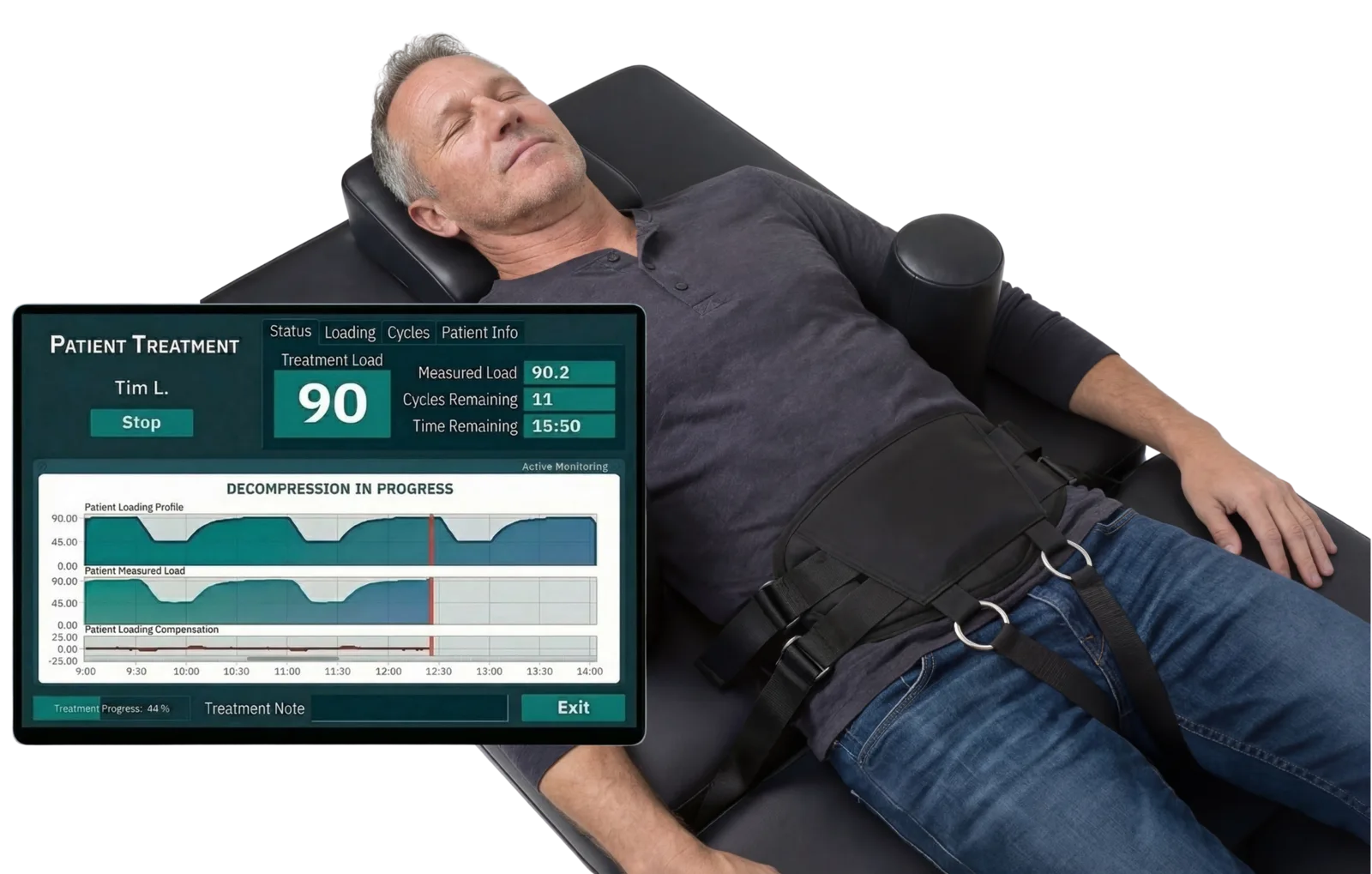
What Exercise and Manual Therapy Can't Reach
Physical therapy strengthens the support system around your spine. But no amount of exercise can create the negative intradiscal pressure that computerized decompression achieves at a targeted disc level.
Pressure comparison
Sources
Nachemson A (1966). The load on lumbar disks in different positions of the body. Clin Orthop Relat Res 45:107–122.
Wilke HJ et al. (1999). New in vivo measurements of pressures in the intervertebral disc in daily life. Spine 24(8):755–762.
Ramos G, Martin W (1994). Effects of vertebral axial decompression on intradiscal pressure. J Neurosurg 81:350–353.
Anderson GB et al. (1983). Intradiscal pressure during traction. Spine 8(2):146–154.
Feature Comparison
Different Tools for Different Problems
| Feature | Physical Therapy | Spinal Decompression |
|---|---|---|
| Primary focus | Strengthening, mobility, movement correction, pain education | Targeted mechanical unloading of a specific disc segment |
| Mechanism | Active exercise, manual therapy, neuromuscular re-education | Computer-controlled cyclical loading with real-time biofeedback |
| Disc-level targeting | Indirect — strengthens surrounding structures but doesn't mechanically unload a specific disc | Direct — positioning, angle, and force calibrated to a specific spinal level |
| Best suited for | Muscular weakness, deconditioning, movement dysfunction, post-surgical rehab, general spinal health | Identified disc-level problems — herniation, bulging, degenerative changes at specific levels |
| Insurance coverage | Typically covered with referral | Typically not covered — structured as a flat-cost care program |
| Combined use | Many providers combine decompression with rehabilitation exercises for optimal outcomes | |
The Best Approach
They Often Work Best Together
The strongest outcomes happen when decompression addresses the disc-level problem and rehabilitation builds the functional support system around it. Decompression without rehab may leave you vulnerable to re-aggravation. Rehab without decompression may not address the disc itself.
Many preferred providers on this platform integrate both — decompression sessions paired with targeted stretching, core stabilization, and postural training. This combined approach reflects how conservative spine care is best delivered: address the specific problem and build the long-term foundation.
This is not an argument against physical therapy
Physical therapy is one of the most valuable conservative interventions available. This comparison exists to explain why patients with identified disc-level problems may need something PT alone can't provide — not to diminish PT's essential role in spinal health and recovery.
Different Problems Need Different Tools
PT builds the foundation. Spine-specific rehabilitation addresses the disc. The question isn't which is better — it's which combination your specific condition requires.


Find a Preferred Provider
Enter your zip code to see if a credentialed provider is available near you.
Why choose a preferred provider?Ready to Find Out If You're a Candidate?
Take our quick 3-minute assessment to see if spinal decompression may be appropriate for your situation. It's free, confidential, and takes just a few questions.
Take the AssessmentGet Started
We've got your info!
We don't have a preferred provider in your area just yet, but we'll reach out as soon as one becomes available.